
Big City Rocks
Central Park was a subduction zone

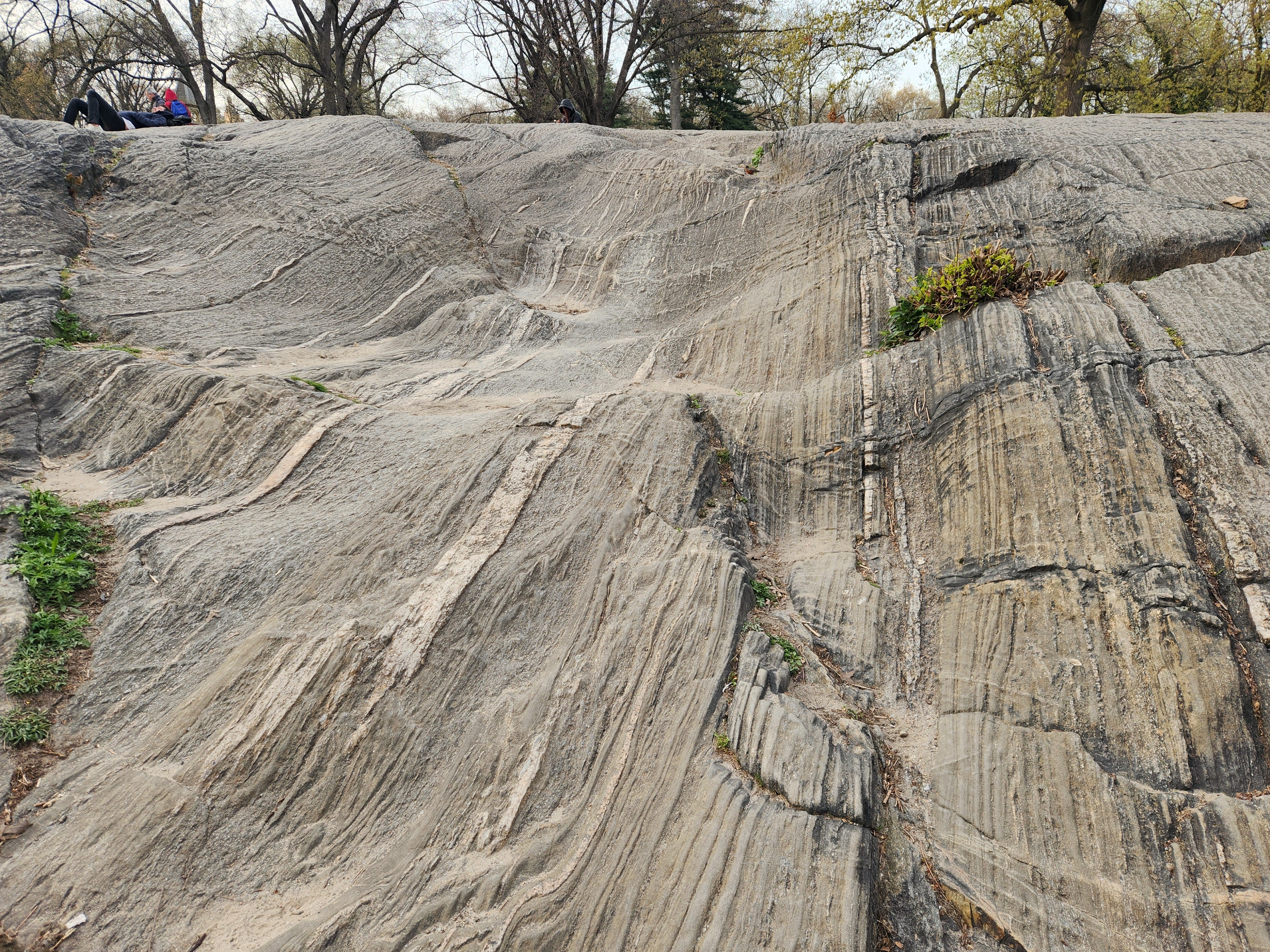
Walking around Manhattan’s Central Park, if you have any interest in geology, you can’t miss the outcrops. They’re everywhere.
Most are schists – the product of sediment scraped off subducting ocean floor, shoved beneath the emerging continent of Laurentia, which today forms the heart of North America, and pressure cooked to produce a layered texture and glittery minerals. According to a guide from by The American Museum of Natural History, which has lots of useful information and field descriptions of various outcrops, chemical analysis of garnets in the schist suggests the original sedimentary rocks were heated to about 600 degrees C and squeezed to pressures of 5,000 atmospheres, or about 5 times the pressure found at the most extreme ocean depths. That means that the rocks were buried as deep as 15 km below the surface.


It all happened between 480 and 440 million years ago (known geologically as the Ordovician era), when modern-day Manhattan lay at the eastern edge of Laurentia. Dense rock at the base of the Laurentia plate subducted to the south below a north-traveling oceanic plate. Just like in today’s subduction zones, the down-plunging plate generated magma, which fed volcanic islands. Meanwhile another subcontinent, called Baltica and now the center of northwestern Eurasia, approached from the east. The offshore volcanic islands and Baltica eventually collided with Laurentia, forming a large mountain chain in eastern Canada and US (see figure, though Baltica is not shown). Those mountains were long since swept away by erosion, but their roots persist in the Piedmont plateau in the Appalachia Highlands.
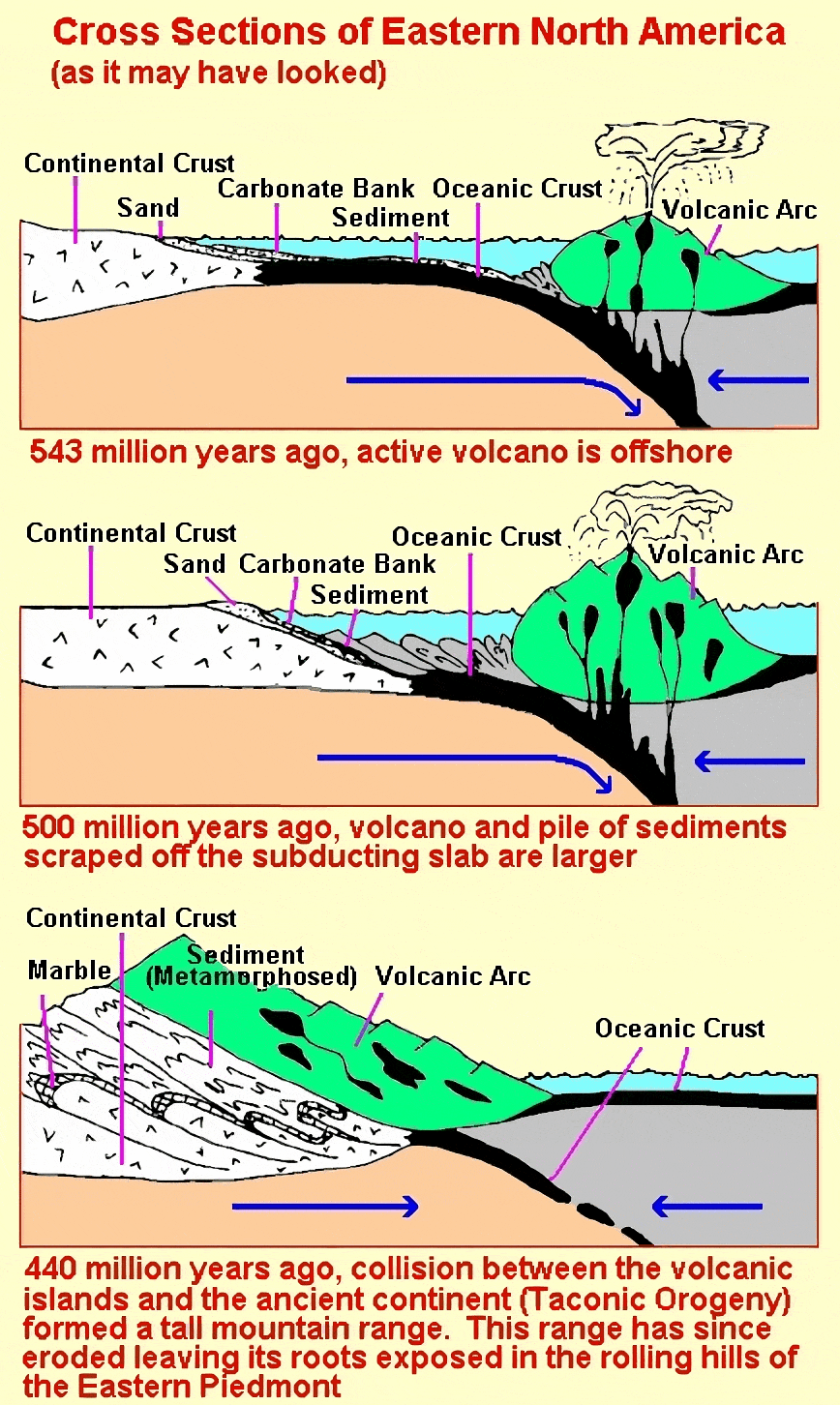
Hundreds of millions of years later, Baltica and Laurentia would split apart again to eventually form today’s landmasses.
As the intervening ocean closed between Laurentia and both the volcanic arc and Baltica, erosion from all 3 shores dumped sediment into the marine waters. Sediment from Laurentia formed a continental slope, and megathrust earthquakes along the subduction zone roiled the sediments, creating landslides that eventually formed distinctive sand and mud formations called turbidites. Other sediments would join them from the volcanic arc and Baltica as the landmasses approached one another, while reefs growing in the tropical waters that became limestones. The island arc and Baltica plowed these deposits forward until some met the downward trench of the subduction zone, which dragged some into heated and pressurized underworld. After metamorphosis at 15 km depth, erosion of the mountains and tectonic forces led to uplift and surface exposure of the schist. Today in Central Park its platforms and rock walls provide climbing structures for kids and lounging spots for residents and tourists.
What is the source of the sediments that became Central Park’s schists? Were they from Laurentia, or the island arc, or Baltica, or a mix of all three? One recent paper (https://www.mdpi.com/2076-3263/14/7/190) suggests the Jutland Klippe sequence in New Jersey as the source of the sediment, and therefore a Laurentian source.
The United States Geological Survey says that the Jutland rocks occur in 8 fragments made up of multi-colored shale and sandstone, with some limestone, dolomite, and embedded pebbles. They were folded and thrust over other formations during the Taconic orogeny, then later deformed during the formation of the Appalachian Mountains between 325 and 260 million years ago, and then once more around 200 million years ago when eastern North America and Europe rifted apart during the breakup of Pangea.
There are two formations that chemically match the Manhattan schists: The Jutland Klippe, a mix of quartz sandstone, shale, limestone, and quartz pebble conglomerate in the New Jersey highlands dating to 497-459 million years ago, and the Normanskill formation, a mixture of shale, sandstone, and turbidites found throughout eastern New York that Natural Atlas says is 471-459 million year old. The authors of the paper peg it as more recent, around 450-445 million years old, which they believe is after subduction had ended, making it impossible that the Normanskill sediments could have gone down the subduction trench.
Only the Jutland sequence matches the time frame of subduction, and its chemical similarity to the Manhattan schist strengthens the argument.